Under the hood
There's no route to build
Here's what actually happens on a storm night, from setup to the last driveway.
During the storm
-
1
Drop your properties once
Put your properties on a map, or import your whole book from a spreadsheet. That's the setup. There is nothing to rebuild when the season changes.
-
2
Every property is scored live
As machines move, Snowmass keeps working out who should take what next — from where everyone is, how long the roads really take, and the direction you want the storm swept.
-
3
Each machine takes its best next stop
The best-placed machine takes the property, and no one else can. Your fleet spreads wide on the opening move, then finishes each block before moving on.
-
4
When a plan breaks, the swarm heals
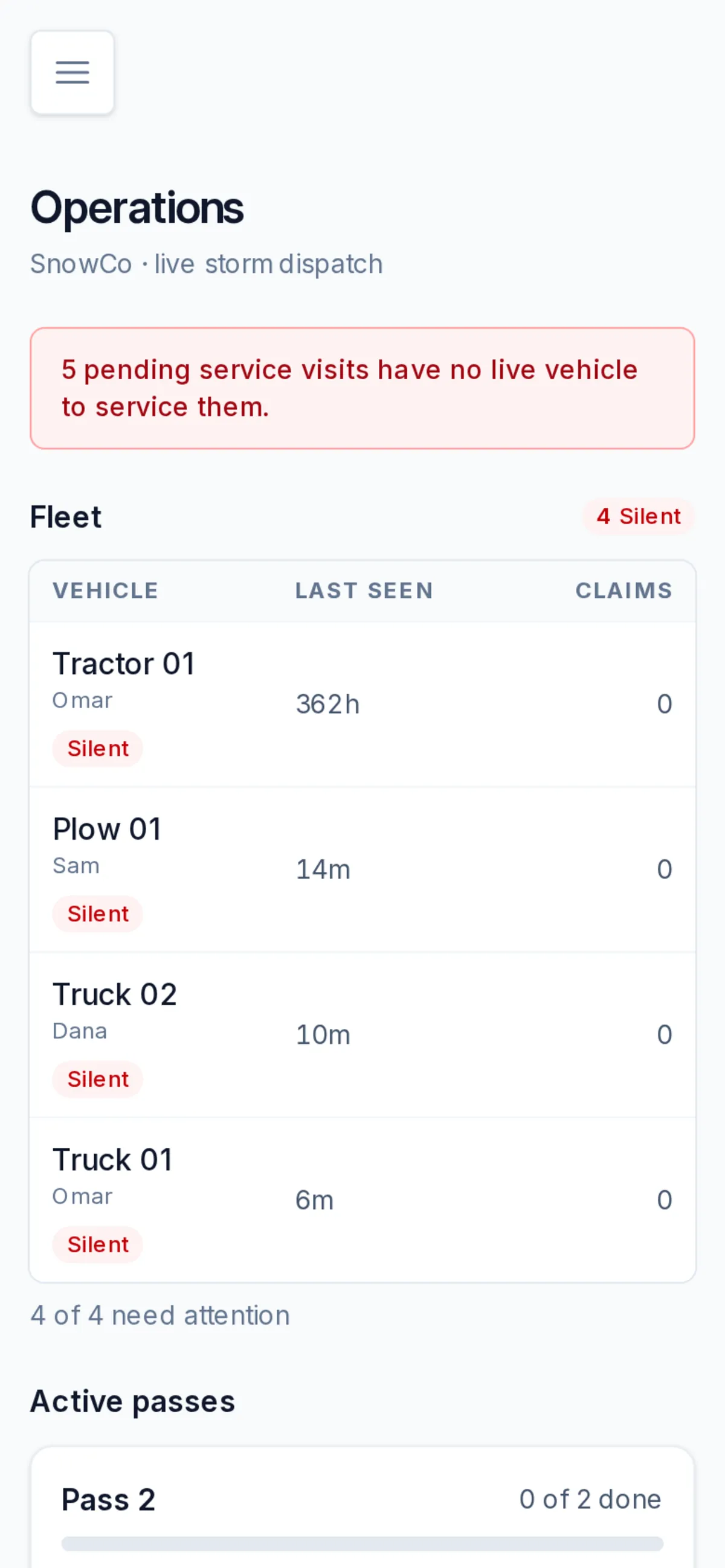
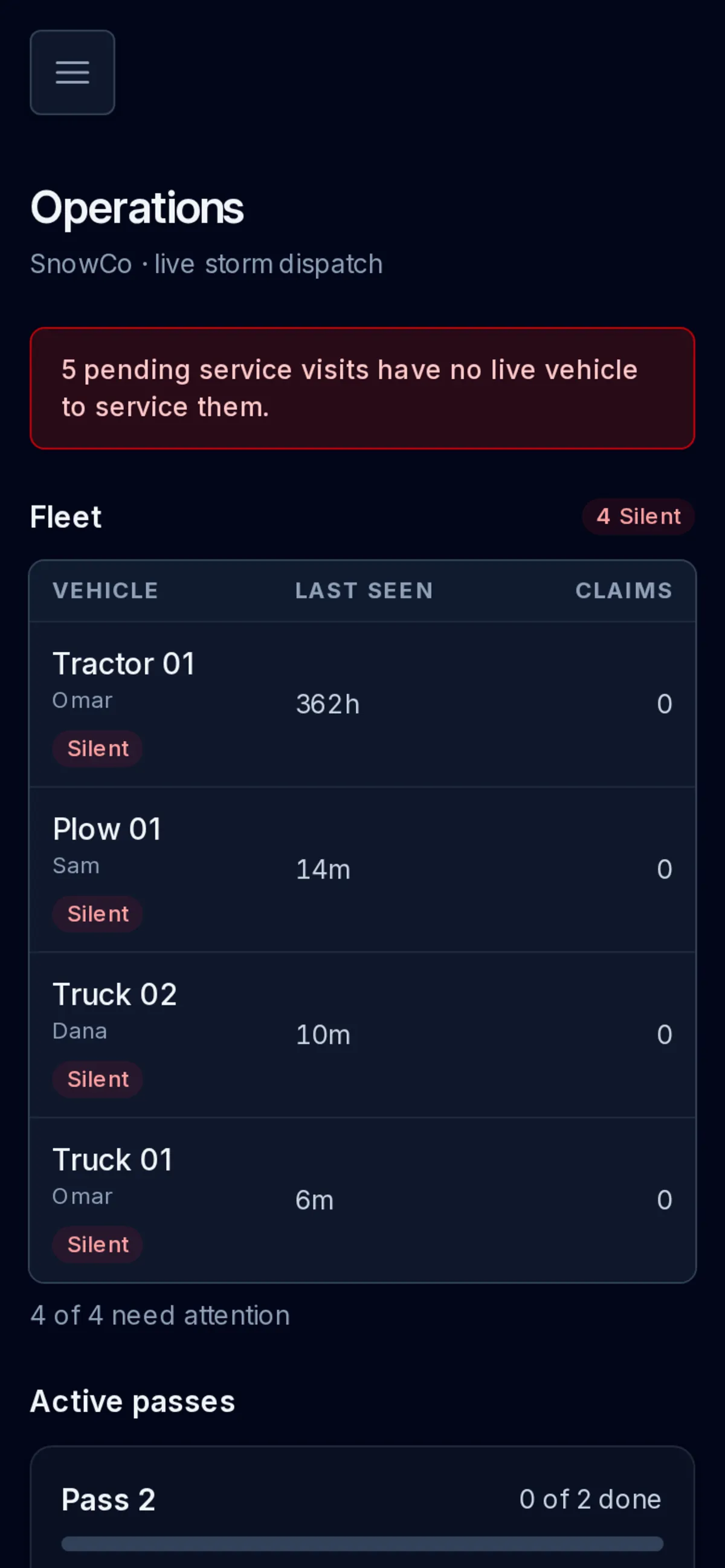
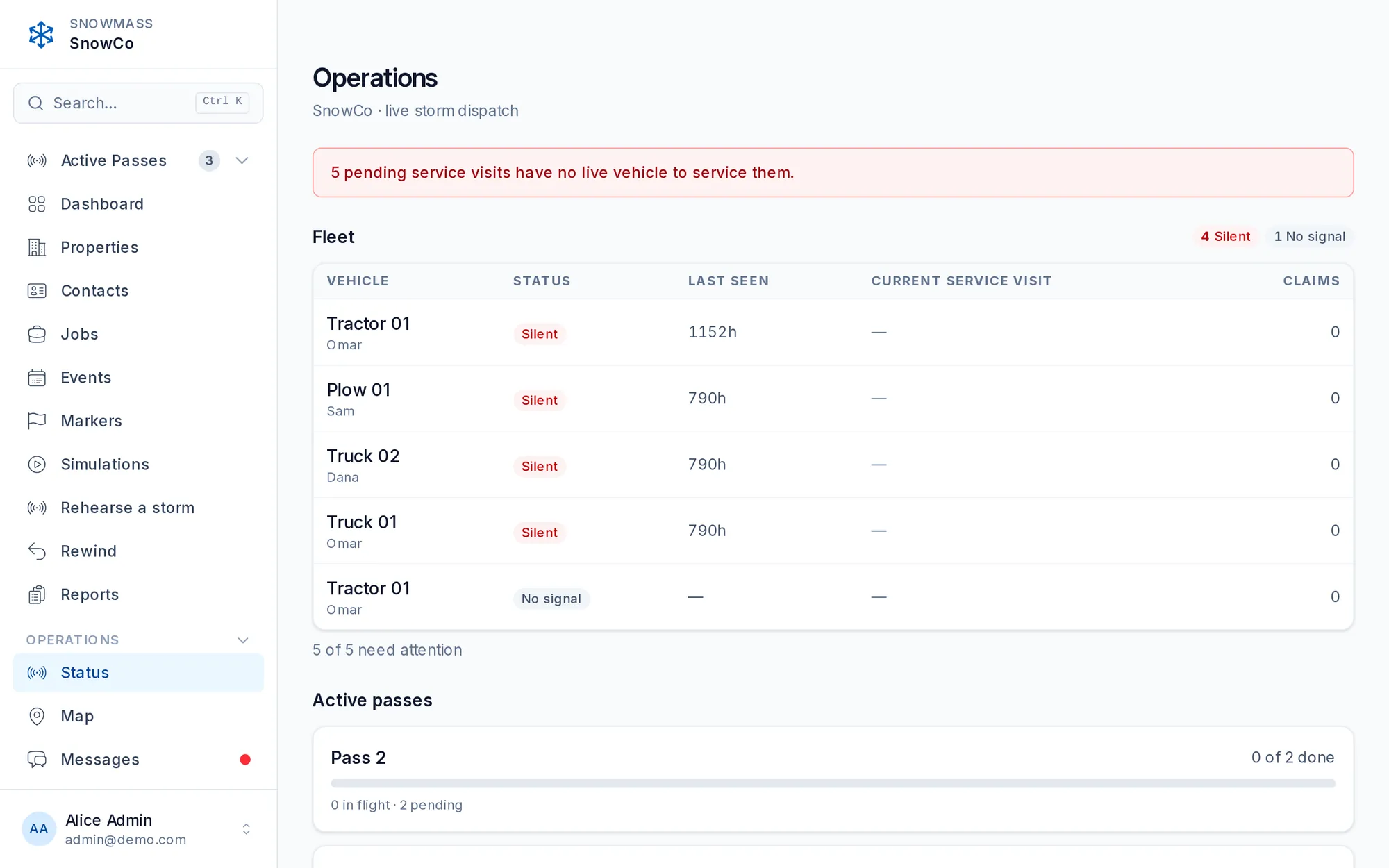
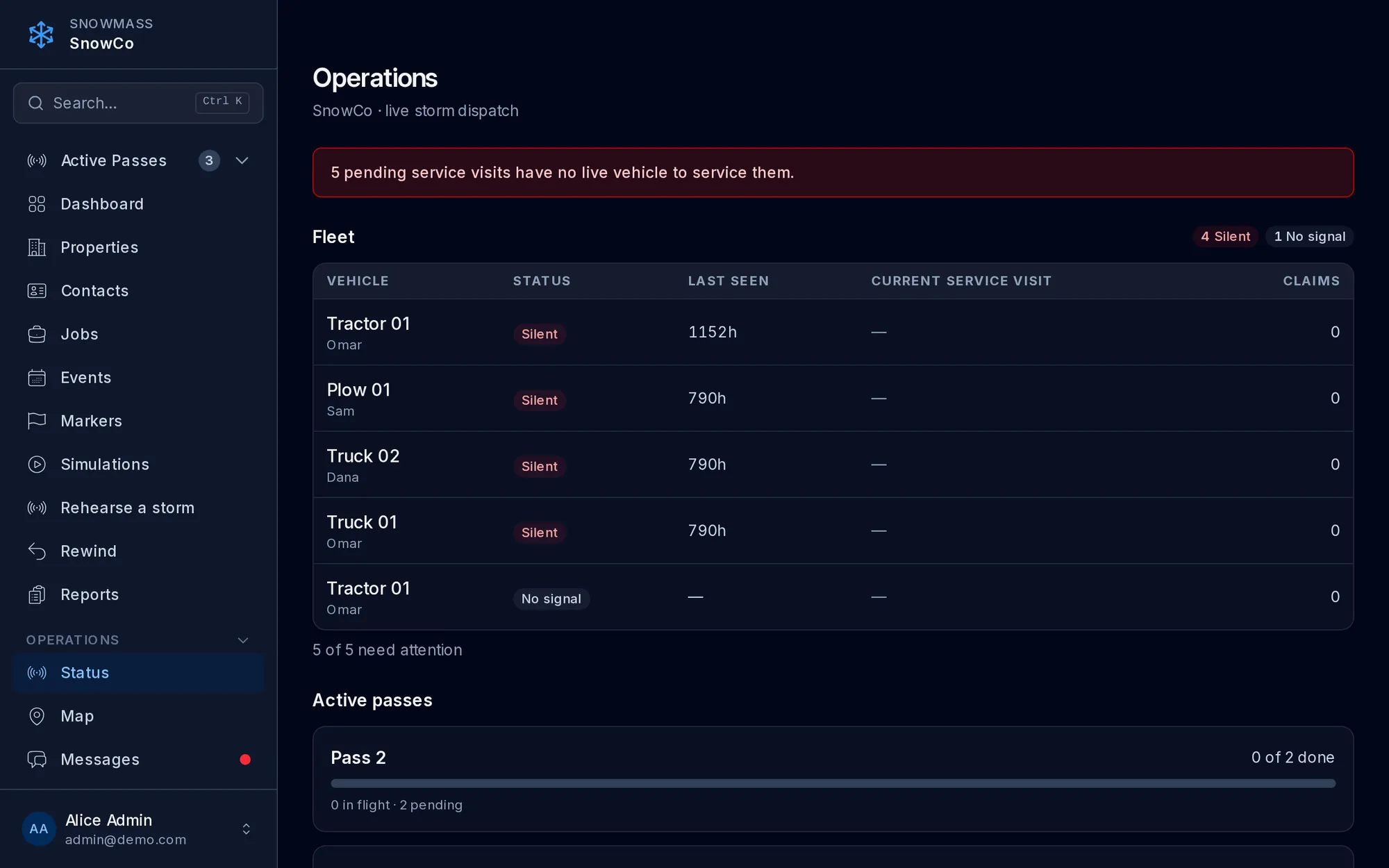
A machine stalls, goes quiet, or gets called in. Its properties go back to the fleet within minutes and someone else picks them up.
-
5
Plow-ridge recheck closes the loop
A road plow re-buries an entrance you just cleared. Your operator marks it, and Snowmass sends someone back after a short wait.
Under the hood
What makes the swarm feel intelligent
How it decides who goes where
Three things, none of them a route you drew last night.
- Where each machine already is, so tight clusters get finished together.
- How long the roads actually take — not a straight line that ignores the river.
- The direction you want the storm swept: outside in, inside out, or nearest first.
Why two machines never show up at once
When a machine takes a property, it is taken. There is no argument to have.
- Two machines reaching at the same instant: one wins, the other moves to its next stop.
- No dispatcher arbitration, and never two crews meeting in the same driveway.
- Which is what lets the fleet keep re-deciding all night without tripping over itself.
The behaviors that keep coverage smart
Sending everyone to the nearest stop would scatter a fleet. A few habits make it sweep like an experienced dispatcher would.
- It fans out wide at the start instead of piling onto one block.
- It finishes a dense block before leaving it. No driving back and forth across town.
- It leaves work with the crew already on that block instead of reaching over their shoulder.
How it heals when reality diverges
The whole point of a swarm is what happens when the plan breaks. Snowmass treats that as a normal night.
- A machine that goes quiet hands its properties back on its own. A dead battery strands nothing.
- Or call one in deliberately, and its work flows straight back to the fleet.
- Work that gets stuck anywhere is spotted and handed back, so nothing quietly stalls.
None of this works without the engine underneath
Live arrival times, simulations, a fleet that heals itself — you cannot bolt any of it onto a fixed route. They exist because the storm is being re-decided all night.
Ready before the next storm
Run a simulation scaled to your fleet, or talk to the team about the season.